
Case Study / Creator Commerce
Audience is not infrastructure.
A creator can sell out a drop from a phone and still have a business held together by tabs, DMs, discount codes, and one very tired spreadsheet. The audience is real. The operating system often is not.
This is not a client victory lap. It is the map we use when we talk to creator-led businesses: where the money leaks, where the work piles up, and where custom software is worth the trouble.
The interesting moment is after the first proof of demand.
Before demand, the creator needs courage. After demand, the creator needs plumbing. A merch drop is not just a product page. It is audience segmentation, launch timing, payments, inventory, shipping, support, fraud prevention, campaign links, refund rules, and a post-mortem good enough to make the next drop less improvised.
The creator economy keeps getting larger, but the daily work remains uneven. Big platforms can move culture. The creator still has to answer the email from a brand, find the right code for a collaborator, and work out why yesterday's post sent traffic but not sales.
The default stack
Tools are fine until they have to agree with each other.
Most creator businesses do not fail because Shopify, forms, or link pages are bad. They fail in the handoffs. A fan becomes a lead in one tool, a buyer in another, a support issue in a third, and a mystery in analytics.
Stress test
Launch day
Stress test
Brand deal
Stress test
Support week
Where it leaks
The loss usually looks boring.
01
Drop timing lives in someone's head.
02
Brand inquiries arrive without context.
03
Waitlists do not separate fans from buyers.
04
The store says what sold, not why it sold.
05
Support quietly becomes a second inbox.
06
Affiliates get codes, but no clean story.
What we would build first.
Not a giant platform. Not a year-long rebuild. The useful first move is a small operating layer around the next commercial moment: a drop, a launch, a partnership push, a product page that finally deserves the audience it is getting.
Layer 1
Launch layer
One place for the drop page, waitlist, countdown, early access, inventory state, and post-drop follow-up.
Layer 2
Deal layer
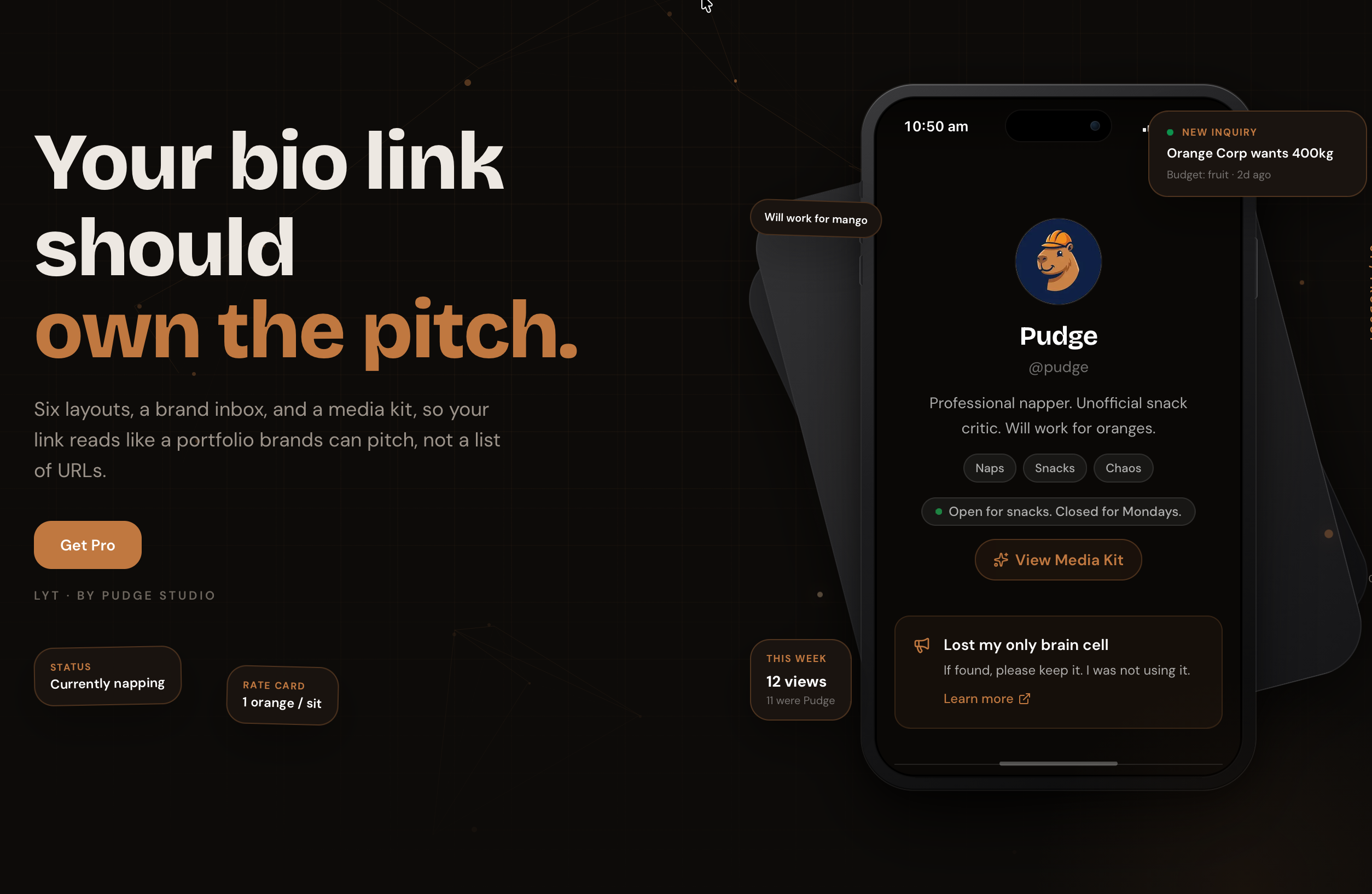
A live media kit, structured brand inquiries, partner notes, rate cards, and a clean path from interest to next step.
Layer 3
Ops layer
A dashboard for orders, support, creator codes, campaign links, refunds, and the boring things that become expensive when missed.
Layer 4
Signal layer
Views, clicks, CTR, top links, sales attribution, and enough history to know what to repeat.
The first offer should feel like a useful diagnosis.
A creator gets pitched constantly. So the opening move cannot be “need a website?” The better offer is an audit: show what will break on the next launch, what should be measured, and which fixes are worth paying for now.

Pudge note
If the creator can point an audience at a link and something sells, the job is not to add more tools. The job is to make the next sale less chaotic.
Sources
Research notes were drawn from the public sources below. The page uses original vector graphics and Pudge Studio-owned product imagery.
Goldman Sachs
The creator economy could approach half-a-trillion dollars by 2027
IAB
2025 Creator Economy Ad Spend & Strategy Report
Linktree
Creator Commerce Report
YouTube Culture & Trends
YouTube Shopping: The Evolving World of Shopping on YouTube
Shopify
Product Drops: The Ultimate Guide to Strategy & Execution
Shopify Enterprise
Product Drop Marketing: Strategy, Steps, and Examples
MBO Partners
Creator Economy Trends Report